If users can’t buy Universal music for their iPods from iTunes, then they’ll either rip a CD or download it illegally elsewhere. On average, music bought from iTunes only accounts for 3% of songs on every user’s iPod. Either way, it won’t impact on iPod sales, which is where Apple makes most of its music-driven revenue, anyway.
read more | digg story
Tuesday, September 04, 2007
Why Apple doesn't need Universal Music


Fuzzy Bush math
You're about to hear that the budget deficit is falling. Don't believe it, warns Fortune's Allan Sloan. The deficit is much, much bigger than you think.
By Allan Sloan, Fortune senior editor-at-large
(Fortune Magazine) -- There will be lots of celebrating in Washington next month when the Treasury announces that the federal budget deficit for fiscal 2007, which ends September 30, will have dropped to a mere $158 billion, give or take a few bucks.
That will be $90 billion below the reported 2006 deficit and will be toasted by the White House and Treasury as a great accomplishment.
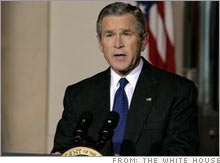
But I have a nasty little secret for you, folks. If you use realistic numbers rather than what I call WAAP - Washington Accepted Accounting Principles - the real federal deficit for the current fiscal year is more than 2-1/2 times the stated deficit.
See the entire article here.
Sunday, September 02, 2007
Are You A Gay Senator
Check this out to see if you are a Gay Senator. You never know till you take the test. (I failed, whatever that means.)
Sold my Hat at Kenny Chesney
I went to my first Country Concert this last Thursday. We saw Kenny Chesney at Madison Square Garden. On the way to the concert I was wearing my old Cowboy Hat that I wear on Vacation. It had been crumpled and sat on and I was going to throw it out but Regina said to wear it. In the city we met a few friends and got something to eat before the concert.
On the street a camera crew approached us to talk about Kenny Chesney. They wanted a man and since I was not the Country Music fan our friend John answered their questions on camera. Before he went on, I gave him my hat to wear. He kicked a-- on camera and I am confident my hat will end up on A&E for a biography of Kenny Chesney. But that's not the end of the story....
At the concert--after a few beers--I was on line getting, what else, another beer. Kenny Chesney was playing and the crowd was hopped up. Then a guy (probably drunk) came up to me and said he wanted to buy my hat for $50. I wasn't going to sell it to him because I told him he was too drunk and probably didn't know what he was doing. He was with a friend who did not try to stop him and the guy proceeded to pull money out of his wallet. He said he didn't have a ten dollar bill so he handed me $60!
I gave him my hat.
I hindsight I might have been able to make change.
Needless to say, my first Country Concert was a success.
--
blah, blah, blah, blah, blah, blah, blah, blah, blah,
blah, blah, blah, blah, blah, blah, blah, blah, blah,
blah, blah, blah, blah, blah, blah, blah, blah, AHA!
---------------------------------------------------------
Lon S. Cohen
Writer
blahblahblah@lonscohen.com
To Good To Be True!
Found on CNN.com:
(CNN)–Senator Larry Craig is hiring some big guns from the legal world, including Michael Vick's lawyer, to represent him in his upcoming legal proceedings.Craig said he has retained Vick's attorney, Billy Martin, to handle most of his legal affairs. He said he has retained Stan Brand, who represented Major League Baseball in connection with the congressional investigation into Major League Baseball’s steroid policies, to handle issues pertaining to an investigation by the Senate Ethics committee.
(If that's not enough:)Also from CNN.com:
President Bush called Craig after Saturday's announcement.
"He told him he knew it was a difficult decision for him and he wished him well," White House spokesman Scott Stanzel said.
The White House's position is that "Sen. Craig made the right decision for himself, his family, his constituents and the U.S. Senate," Stanzel said.
(In light of my recent post this is too ironic! In addition, Craig is in a state of denial... I mean he is denying he is guilty.)
Monday, August 27, 2007
Michael Vick Finds Jesus, Hellelujha
Michael Vick has admitted to the charges brought against him and then proclaimed in a news conference that, "Through this situation I've found Jesus." He vowed to redeem himself, saying, "I have to."

After his guilty plea, Michael Vick tells reporters Monday he takes responsibility for his actions.
Why do these guys always go right to Jesus when they get in trouble? Jesus is already busy with Rove and Gonzalez and the crisis of the coming Armageddon, now he's got Michael Vick knocking on his door:
"Hey Jesus," Michael Vick said. "I found you."
Jesus looks through the crack in his front door, still chained shut. "Vick, what's up?"
Vick looks down, embarrassed. "I need a little to tide me over, y'know, or they're gonna take away my crib. Just until I get back in the NFL."
"Yeah, well." Jesus scratches his head. "I donated all my allowance this year to the GOP."
"Snap," Vick says. "Well, they need it more than me, I guess."
"Why don't you ask my Dad? He's across the street."
"How do you think I got into the NFL into the first place?"
"Right... Well there's always the other guy." Jesus points downward.
"I'm ducking that guy. I owe him rent for the dogs."
"Tough luck. Well, tell Pete Rose I said hey."
"Peace out." Michael Vick turns and walks away.
"And also with you." Jesus shuts the door.
"Who was that, honey?" Mary Magdalene calls from the kitchen.
"It was Mike Vick!"
"What did he want?"
"He wanted to borrow money."
"How'd he find you?"
"I think he got my number from Larry Craig.**"
** (CNN) -- A Republican senator pleaded guilty earlier this month to a misdemeanor disorderly conduct charge stemming from his arrest at the Minneapolis-St. Paul International Airport, according to state criminal records.

Republican Sen. Larry Craig of Idaho was arrested in June at Minneapolis-St. Paul International Airport.
Roll Call newspaper reported Monday that Sen. Larry Craig of Idaho was apprehended June 11 by a plainclothes police officer investigating complaints of lewd behavior in an airport men's room.
For a list of other Republican Scandals go here at Salon.
Or better yet try the illustrated and interactive guide at Slate.
***From Wikipedia: In 2004, Foley sent five e-mails to a 16-year-old former page from Monroe, Louisiana sponsored by Rep. Rodney Alexander (R-LA). They were the first messages to be made public in the scandal. Among other things, Foley asked for a photo of the page, his age and birthday, and what he wanted for a birthday present. Foley observed that another male page (to whom he had also written) was "in really great shape... i am just finished riding my bike on a 25 mile journey..." The page forwarded the e-mails to a colleague in Alexander's office, saying "this really freaked me out," and repeating the word "sick" 13 times to describe the photo request. The page asked "if you can, please tell Rodney [Alexander] about this," and in addition, mentioned a female page who had been warned about a Congressman who "hit on" interns.

Mark Foley
ABC News reported on October 5 that in 2002, Foley e-mailed one page with an invitation to stay at the congressman's home in exchange for oral sex. The page, who was 17 years old at the time, declined the offer. The same report stated that he e-mailed another with a request for a photograph of his erect penis. Another former page reports that he saw sexually explicit e-mails sent to one page from his page class of 2001-2002, and learned of "three or four" pages from that class who received similar e-mails.
Sample Emails:
An exchange that took place in April 2003 apparently reveals Foley engaging in cybersex with an eighteen-year-old former page as the House voted on an emergency supplemental appropriations bill to fund the Iraq War; the released portion does not contain the purported cybersex exchange:
Maf54: ok..i better go vote..did you know you would have this effect on me
Teen:   lol I guessed
Teen:   ya go vote…I don't want to keep you from doing our job
Maf54: can I have a good kiss goodnight
Teen:   :-*
Teen:
In another exchange, Foley appeared to invite the same page to his apartment with a friend to consume alcoholic beverages:
Maf54: we will be adjourned ny then
Teen:   oh good
Maf54: by
Maf54: then we can have a few drinks
Maf54: lol
Teen:   yes yes ;-)
Maf54: your not old enough to drink
Teen:   shhh…
Maf54: ok
Teen:   that's not what my ID says
Teen:   lol
Maf54: ok
Teen:   I probably shouldn't be telling you that huh
Maf54: we may need to drink at my house so we don't get busted
Other exchanges show Foley as carefully planning to avoid illegal sexual contact:
Teen: im not 18 till feb 23(Oh BOY! Is it hot in here or is it just me?-L.S.C.)
Maf54: i know.
Maf54: nothing will happen
Maf54: just dreaming
Maf54: don't worry
Teen: ya im still 17 till feb 23
Maf54: see you feb 24th
Small detail: Foley was chairman of the House Caucus on Missing and Exploited Children, which introduced legislation targeting sexual predators and created stricter guidelines for tracking them. (Wikipedia.)
Another interesting outcome from Mark Foley case: On October 3 Foley’s lawyer stated, "Mark Foley has never, ever had inappropriate sexual contact with a minor in his life. He is absolutely, positively not a pedophile." He also stated that Foley himself was a victim of sexual assault by an unnamed clergyman as a child, that the inappropriate conversations were the result of a secret alcohol problem and primarily occurred while Foley was intoxicated, and that Foley is gay. Previously, when confronted with speculations that he was gay, Foley labeled them "revolting and unforgivable." However, Foley's homosexuality had been an open secret in Washington for many years.
After demands to do so, Foley privately identified the priest he alleged had abused him as a child. However, the public revelation of his identity, Anthony Mercieca, 69-year old Catholic priest now living in Malta, came through the investigative reporting of the Sarasota Herald-Tribune.
Here is what Pope John Paul II had to say about the scandal:
“As priests we are personally and profoundly afflicted by the sins of some of our brothers who have betrayed the grace of ordination in succumbing even to the most grievous forms of the mysterium iniquitatis at work in the world. Grave scandal is caused, with the result that a dark shadow of suspicion is cast over all the other fine priests who perform their ministry with honesty and integrity and often with heroic self-sacrifice. As the Church shows her concern for the victims and strives to respond in truth and justice to each of these painful situations, all of us...are called to embrace the ‘mysterium Crucis’ and to commit ourselves more fully to the search for holiness.”****
(****According to some interpretations of this statement, it seems that the Pope had excused the actions of the priests as not crimes or evil acts but the succumbing to some "mysterium iniquitatis" in the world. Not sure if that condemns the guilty priests or the innocent victims. Perhaps the little boys should have worn their little alter boy skirts a little lower to hide their "mysterium iniquitatis" from the poor priests.)
Nuri al-Maliki says, Iraquis want U.S. Soldiers but U.S. Senators can mind their own bee's wax.
BAGHDAD, Iraq (CNN) -- Faced with walkouts by members of his government and increasing criticism from U.S. officials, Iraqi Prime Minister Nuri al-Maliki told U.S. senators Sunday to butt out of his country's domestic politics.

Iraqi Prime Minister Nuri al-Maliki, shown August 16, accused U.S. lawmakers of "severe interference."
"There are American officials who consider Iraq as if it were one of their villages, for example Hillary Clinton and Carl Levin," al-Maliki told reporters in Baghdad. "This is severe interference in our domestic affairs."
(The Prime Minister of Iraq need not to worry about America's politicians. If he's campaigning for the Republicans then he gave the Dems a big gift. al-Maliki's involvement in his own country's affairs should be his biggest concern. Not the U.S. We've been there getting killed for his people while they screw up every opportunity worse than the neo-cons.)
Tom Monaghan, Domino's Pizza Founder Builds Catholic Town
AVE MARIA, Florida -- We drove for miles and saw nothing but endless plains of green, on the edge of the lush Florida Everglades. And then there it was: a giant cathedral rising from earth, surrounded by a European-style piazza of soon-to-open businesses and restaurants. It was Ave Maria, a town built from scratch, founded and funded by billionaire Tom Monaghan. His vision: a community that would reflect traditional Catholic values.
Read more about Tom's town here.
(Now it makes sense why they wouldn't hire me for the pizza delivery job in the late eighties unless I cut my mullet!)
Stephon Marbury on Michael Vick
If Michael Vick needs a character witness, he should consider Stephon Marbury. "He is a good human being," the Knicks player said about Vick. "He just fell into a bad situation."
Marbury was just getting started.
"We don't say anything about people who shoot deer and shoot other animals. From what I hear, dog fighting is a sport. It's just behind closed doors," Marbury told Capital News 9, a TV station in Albany, New York.
Read more here about Michael Vick.
(I'm just going to start posting there crazy little things from other RSS Feeds I subscribe to.)
Nightmarish political realities in Baghdad
BAGHDAD, Iraq (CNN) -- Nightmarish political realities in Baghdad are prompting American officials to curb their vision for democracy in Iraq. Instead, the officials now say they are willing to settle for a government that functions and can bring security.
(Am I the only one who finds this to be ironic?)
Read about Nightmarish political realities in Baghdad here.
Tuesday, July 31, 2007
Energy Seminar At HIA Conference
The Hauppauge Industrial Association’s Energy Seminar Takes Long Island Business From Science Fiction To Science Function.
By Lon S. Cohen
SCCC, Brentwood Campus—No matter which way you look at it, an investment in Alternative Energy is good for our health, environment, economy, and political standing in the world. The Energy Seminar at HIA’s Trade Show focused on the business of Alternative Energy.
Patrick Foye, Co-Chairman of the Empire State Development Corporation was the ringmaster of a distinguished and impressive panel of Long Island’s top experts in the energy arena. They included, Robert B. Catell, Chairman and Chief Executive Officer of Keyspan Energy; Dr. Yacov Shamash, Vice President for Economic Development and Dean of the College of Engineering and Applied Sciences at Stony Brook University; Dr. Ralph James, Associate Laboratory Director for Energy, Environment and National Security of Brookhaven National Laboratory; and Mr. Bruce Germano, Vice President of Retail Services for LIPA.
A few basic questions were posed to the audience about the business of Alternative Energy:
1) Who is using the energy?
2) Why should we be concerned with reducing our dependency on fossil fuel that is primarily imported from overseas?
3) What do we gain as a society by investing in Alternative Energy Solutions?
4) Finally, how do we go about making the necessary changes?
The first two questions have been debated endlessly in political and social circles. Vehicles contribute a major portion of the greenhouse gasses to the environment, our increasingly technological society is using more energy, and alternative energy sources are sometimes hard to integrate into a society whose economy is so plugged-into (pun intended) the traditional energy grid. Expense in human lives and in money to preserve the status quo is a major concern, along with the threat to our environment.
With the density of government agencies, businesses and academia, Long Island can become a leader in Alternative Energy and Efficiency technology businesses and answer the last two questions.
First, Steve Israel (D-NY 2nd) provided a literal talking head, as he could not attend the event because of a vote he needed to attend in Congress, by way of a prerecorded video. His Next Generation Energy Security Plan is based on the fact that “our biggest vulnerability in the world is our dependence on foreign oil.”
On his website, Mr. Israel says: “Just like the space program succeeds by unleashing the ingenuity of the private sector with major tax incentives and federal support,” he hopes to infuse that same spirit in the energy sector.
Moderator Patrick Foye outlined the hurdles that we face. The high cost of energy is an impediment to economic development. Many corporations have all made successful commitments to reduce energy consumption while maintaining (or even increasing) productivity so it is possible for Long Islanders to do the same.
Dr. Yakov Shamash spoke at length about the endeavors at Stony Brook University. Research into fossil fuel efficiency, and improving the performance of computer chips and fuel cells are fertile ground for local companies. Like a Michael Creighton novel, no corner of the earth is left out in the search for new fuel resources and Dr. Shamash spoke about extracting Hydrogen for fuel from the ocean floor!
LIPA’s Bruce Germano talked about the extremely progressive concept of a “self healing, smart, electrical grid.” A computer system overlain on the grid’s backbone will use extensive data, including availability and price of electricity, to distribute and regulate the flow of wholesale electricity to intelligent appliances. Also the stuff of Science Fiction brought to today’s world.
Back in the 21st Century, Keyspan’s Robert Catell presented a readily available cleaner burning, energy source: Natural Gas. Research into making Natural Gas lower in emissions is continuous. Also, Keyspan’s Islandia home is also providing temporary space for Stony Brook University’s Energy Center.
Ralph James, an Associate Director at Brookhaven National Lab, spoke about research into Bio, Solar and Nuclear Energy. The Lab offers extensive access for small businesses to work with them on these technologies. Mr. James called for a move from the rhetorical to the practical in our debate so Long Island can benefit from the National Energy Policy’s call to build new Energy Centers.
Our country can become energy independent. Exciting opportunities—and let’s face it, profitability—will provide essential energy technology through businesses brave enough to take up the challenge.
With Long Island’s dense concentration of entrepreneurs, academia, government organizations and large utilities, we can benefit from the inevitable energy revolution. Water, tidal, solar and wind power are in abundant supply here, along with the people and tools to utilize nature’s freely available clean energy resources at the bleeding edge of current technology. (And the minds that can imagine turning the stuff of Science Fiction into Science Function!)
Orinially Published in "The Hauppauge Reporter"
Monday, June 25, 2007
BUSH: A tragic legacy | Salon Books
We all remember how many religious wars were fought for a religion of love and gentleness; how many bodies were burned alive with the genuinely kind intention of saving souls from the eternal fire of hell. -- Sir Karl Popper, twentieth-century British philosopher of science
read more | digg story
Wednesday, June 20, 2007
Lon S Cohen - Review of Articles
See below for a review of articles that I published so far on Hamptons.com:
Music Column
Lone Sharks
Hamptons.com Music Calendar
Nancy Atlas Live CD
Stand
Nancy Atlas
LUMA
Caroline Doctorow
Creamsicles
Satire
Hamptons Couples
Summer Camp
Mortgage
Golf
Borat
April
Celebrity Homes
Forbes 500
Beer
Random Acts Of Traffic
By Lon S. Cohen
lon@lonscohen.com
Everytime I’m on the L.I.E. it’s inevitable that I get trapped behind some vehicle with a magnetic yellow ribbon that says Support Our Troops like some modern version of the ones Tony Orlando made famous in the Seventies. I have nothing against the ribbons or our troops. I love our troops. I want them all to be safe and sound. That’s not the point.
The thing that makes me scratch my head in wonder is when I see those yellow ribbons on the back of a Hummer. A Hummer! You can draw your own conclusion but let me help with the Cliff’s Notes version: Big truck. Guzzles gas. War in the Middle East. ‘Nuff said?
We already know that oil and water don’t mix. But what about oil and ego? They seem to find each other like tinfoil-hat-wearing trailer-park-dwelling yokels find UFOs. Look at the oil barons and the dictatorships of the Middle East. You know, with the way they rule the world economy and supress the masses and all that other stuff they do that’s not really very nice to do to other people.
That’s not supposed to be funny. It’s ironic.
What if we could harness the power of the sun, which has plenty of energy for all of us and doesn’t really want much in return (at least for the next few billion years or so)? Guess what makes the energy for the sun to burn. If you said oil, wood, coal, revenge, or unrequitted love you’d be wrong. It’s Hydrogen. Just plain old simple Hydrogen. Numero Uno on the Periodic Table of Elements.
Gasoline is made of like, what? A dozen Hydrogen atoms and a bunch of Carbon atoms? It doesn’t even come out of the ground like that. It comes out in a sticky goo of all those atoms stuck together. Then we have to bribe people to get on the land, steal the land from poor people, pay millions and millions of dollars for other countries to pump it out of the ground, wait until they build big castle-sized houses out of gold bricks, put the oil in containers, ship it over the ocean for thousands of miles to America where they boil it, separate it, make the goo into different kinds of other stuff (some of it gasoline). Then they put it in trucks, drive it all over the place, put it in more tanks at the gas station and wait for you to go to work, make some money, go to the Hummer dealer, buy one, then drive all the way to the gas station, pay some money and pump it into another tank inside your Hummer. While you’re there you buy a little yellow ribbon with the change to stick on the bumper.
Sun makes energy from sqeezing Hydrogen really, really tight, sustaining every form of life on this big beautiful world.
Hummer makes energy from big paragraph above.
I’ll be honest with you. I don’t know much about the politics of the oil industry per se. All that I know is that I need gasoline. Desperately. You need gasoline. Desperately. How much time do you spent in a gas station. Think about it for a minute. It’s almost every other day. On average you probably spend more time in bed or if you’re lucky, in the bathroom. No wonder they control the world! If toilet bowls or mattresses where a limited natural resource we’d be in trouble. We’d have toilet taxes and sleeping tarrifs. The bush league sons of porcelin mining company CEOs would be president!
Perhaps I don’t know all that much about the oil industry or the mattress indiustry. I definitely don’t know any thing about the toilet bowl game. And I definitely-definitely do not pretend to know the machinations that control our oil interests as they affect international policy. But what I do know is irony. That I can grasp. I can pretty much spot irony when I see it for what it is.
For example, ironic is that a guy who has the nerve to drive a big gas guzzling mostrasity like a Hummer doesn't find it the least bothersome to fill it with about $98 worth of gas and spends the two dollar change on a little yellow ribbon magnet honoring those who fight in Iraq!
I find this lack of ironic sense, well, ironic.
Not to say that everyone who drives a Hummer is a big lunkhead with no sense of irony. I'm sure there's one guy out there, driving a big Hummer, who voted for Ralph Nader, and then slapped a little yellow ribbon on his gigantic Hummer because he thinks he’s funny.
If you’re out there, please let me know.
Friday, June 15, 2007
Kellogg to raise nututritional value of cereal because of fat kids?
Raising the nutritional value of cereal is good but the reason is lame. Parents sue because they have fat kids? Kellogg will not use Shrek to advertise cereal anymore. I guess the parents will feel better when the kids are eating healthy cereal while they sit on the couch watching Shrek and playing the Shrek video games. Yeah that makes sense.
read more | digg story
Monday, June 11, 2007
Erosion - Lulu.com
Canyon Park is bowed down under a relentless torrent of rain. The fields are flooded, the bridges crumble and the increasingly isolated town is host to a serial killer with a grudge against the wealthy Lollo family.
read more | digg story
Tuesday, May 29, 2007
28 New Exoplanets Found!
Astronomers have discovered 28 new planets outside of our solar system, increasing to 236 the number of known exoplanets, revealing that planets can exist around a broad spectrum of stellar types-from tiny, dim stars to giants.
read more | digg story
Wednesday, May 16, 2007
We Reap What We Sow
The following email ended up in my inbox at work. I responded to it as I have stated below. It was sent to me by some blow-hard, do nothing who likes to run on and on and on about how we are still going to find hidden WMDs in Iraq and that Hillary Clinton deserves to go to jail because of some consiprosy theory he though up.
Read the email and then my response below it:
Subject: Fw: "WE REAP WHAT WE SOW,"
WOW, WHAT A WAKE UP!
Dear God: Why didn't you save the school children at ?.
Bath, Michigan 1927
Houston, TX 1959
Moses Lake , Washington 2/2/96
Bethel , Alaska 2/19/97 Pearl ,
Mississippi 10/1/97
West Paducah , Kentucky 12/1/97
Stamp, Arkansas 12/15/97
Jonesboro , Arkansas 3/24/98
Edinboro , Pennsylvania 4/24/98
Fayetteville , Tennessee 5/19/98
Springfield , Oregon 5/21/98
Richmond , Virginia 6/15/98
Littleton , Colorado 4/20/99
Taber , Alberta , Canada 5/28/99
Conyers , Georgia 5/20/99
Deming , New Mexico 11/19/99
Fort Gibson , Oklahoma 12/6/99
Santee , California 3/ 5/01
El Cajon , California 3/22/01
and Blacksburg, Virginia 4/16/07?
Sincerely, Concerned Student
-----------------------------------------------------
Reply: Dear Concerned Student:
I am not allowed in schools.
Sincerely, God
----------------------------------------------------------
How did this get started?...
-----------------
Let's see, I think it started when Madeline Murray O'Hare complained she didn't want any prayer in our schools. And we said, OK..
------------------
Then, someone said you better not read the Bible in school, the Bible that says "thou shalt not kill, thou shalt not steal, and love your neighbors as yourself," And we said, OK...
-----------------
Dr. Benjamin Spock said we shouldn't spank our children when they misbehaved because their little personalities would be warped and we might damage their self-esteem. And we said, an expert should know what he's talking about so we won't spank them anymore..
------------------
Then someone said teachers and principals better not discipline our children when they misbehave. And the school administrators said no faculty member in this school better touch a student when they misbehave because we don't want any bad publicity, and we surely don't want to be sued. And we accepted their reasoning...
------------------
Then someone said, let's let our daughters have abortions if they want, and they won't even have to tell their parents. And we said, that's a grand idea...
------------------
Then some wise school board member said, since boys will be boys and they're going to do it anyway, let's give our sons all the condoms they want, so they can have all the fun they desire, and we won't have to tell their parents they got them at school. And we said, that's another great idea...
------------------
Then some of our top elected officials said it doesn't matter what we do in private as long as we do our jobs. And we said, it doesn't matter what anybody, including the President, does in private as long as we have jobs and the economy is good....
------------------
And someone else took that appreciation a step further and published pictures of nude children and then stepped further still by making them available on the Internet. And we said, everyone's entitled to free speech....
------------------
And the entertainment industry said, let's make TV shows and movies that promote profanity, violence and illicit sex... And let's record music that encourages rape, drugs, murder, suicide, and satanic themes... And we said, it's just entertainment and it has no adverse effect and nobody takes it seriously anyway, so go right ahead.
------------------
Now we're asking ourselves why our children have no conscience, why they don't know right from wrong, and why it doesn't bother them to kill strangers, classmates or even themselves.
------------------
Undoubtedly, if we thought about it long and hard enough, we could figure it out. I'm sure it has a great deal to do with... "WE REAP WHAT WE SOW,"
------------------
Pass it on if you think it has merit! If not then just discard it... but if you discard this thought process, then don't you dare sit back and complain about what bad shape this country is in.
End of email.
What a sloppy piece of crap that is huh?
I am not sure that anyone actually reads the bible or goes to church/temple/mosk anymore before they send out emails like this.
God is infinite and according to Aristotle He is the Unmoved Mover, which means he is the beginning of the Universe as the First Cause that causes everything that has happened since the beginning of time. As I understand from reading the Torah, God is not swayed by public policy.
As a practicing Jew I find this email to be disgraceful. How dare anyone put words into the mouth of the Almighty to prove their point. This was not written by a little girl.It was probably written by some nut with an agenda to play on people's emotions so that they would write their Congressperson and make it OK to pray in school. Of course I am sure that the originator of this email was not considering that Jews, Hindus, Muslims and Native Americans all attend public school and therefore have the right to pray in their houses of worship and homes as they please without some rightwing, Conservative, fascist, nut, telling them they HAVE to pray to Jesus Christ in school or they will go to hell and their children will be shot to death in mass murders.
As long as the Constitution protects the rights of individuals to worship as they truly want, without the government meddling into their personal relationship with God then people who want to enforce public school prayer are truly Un-Patriotic and Un-American.The government protects our rights in this democracy. It does not enforce the will of the elite upon those in the minority. I believe that was what the Revolutionary War and Declaration of Independence was supposed to do anyway.I am not positive but I think that in all the school shootings, the shooters were not disciples of God bringing vengeance upon the masses.
I agree that most of the generations that came before me had it very hard. As well, I see that generations after me will have easier lives. It is also true that every generation has its unique problems and issues. In my great-grandfather's generation he and his family had to escape from Poland to France on foot to then take a boat to America because of the pograms killing Jews. My grandfather's generation had to fight in WW2 and deal with the Japanese invasion of Pearl Harbor AND Hitler AND the Cold War with Russia. The following generation had to deal with Korea and more importantly the Vietnam conflict and all that came with it. In my generation we were still doing Nuclear Bomb scares in elemetary school, hiding under our desks and even after the malaise of the Seventies in the Eighties I grew up with the threat of Nuclear War. The Nineties saw the rise of terrorism and now my children live in the most suspicious and security concious America ever. Schools doors are locked down, people will call the cops because teenagers are walking around their neighborhood, and everyone thinks everyone else is either a traitor or a terrorist cell. Of course just like Pearl Harbor, Nine-Eleven and its aftermath will take a long time to recover, not just the hurt but the fear, hate and division in the country that it caused.
That said, If I read the above email I can't make the logical connection between Dr. Spock and School shootings. It seems that the availability of such items along with the fracture in family values (true family values that can be upheld in any type of family even mine where my mother raised me as a single mother) contributes greatly. The best thing you said was we have to take responsibility for our own actions. Whether right or wrong, I own my mistakes but I also own my sucesses. That comes with the territory.
People who send emails like that without thought to the content make me angry because I can't see spreading hate as policy in America. Whatever happened to intelligent discourse and being able to disagree, have conversation and debate without one side or another claiming the other side is either a terrorist, unpatriotic or souless?? Great men like, FDR, Truman, Ronald Reagan and George Bush Sr. had respect for their opponents.
I disagree that Bill Clinton's actions in the White House lead to children being killed as the email implies. What a crock! It seems to me that lying to the American Public and to Congress and then turning around and blaming THEM for believing the lies is about as unpatriotic as you can get. Regardless of who does it. When I learned about American Government in elementary school I learned about the foundation of our system: Checks And Balances! That's why we don't have ONE branch of government, but three. That's why we don't mix religion and government. Religion is about the soul and family and death, Government is about society, taxes and policy. Religion is about things we have to have faith to believe. Government is a structured organization that serves the people. I think it is called Democracy.
Besides the sender of that email is a big blow hard with nothing useful to say but to toot his own horn about how great he is but accomplishes very, very little that is creative or good for his fellow man.
Personally I love a good argument and debate. I learn something from every intelligent conversation and disagreement I have with people. But some people have nothing to contribute.
Lon S. Cohen
Subscribe to:
Posts (Atom)


